
What is CiteScore? A Researcher's Guide to the Journal Metric
In the world of academic publishing, numerous metrics exist to measure the influence and impact of a scholarly journal. For decades, the Journal Impact Factor was the dominant player. However, a newer, more transparent metric has become increasingly important: CiteScore.
If you're a researcher, student, or academic, understanding CiteScore is essential for evaluating where to publish your work and for assessing the quality of your sources. So, what exactly does CiteScore mean, and how does it work? This guide breaks it down in simple terms.
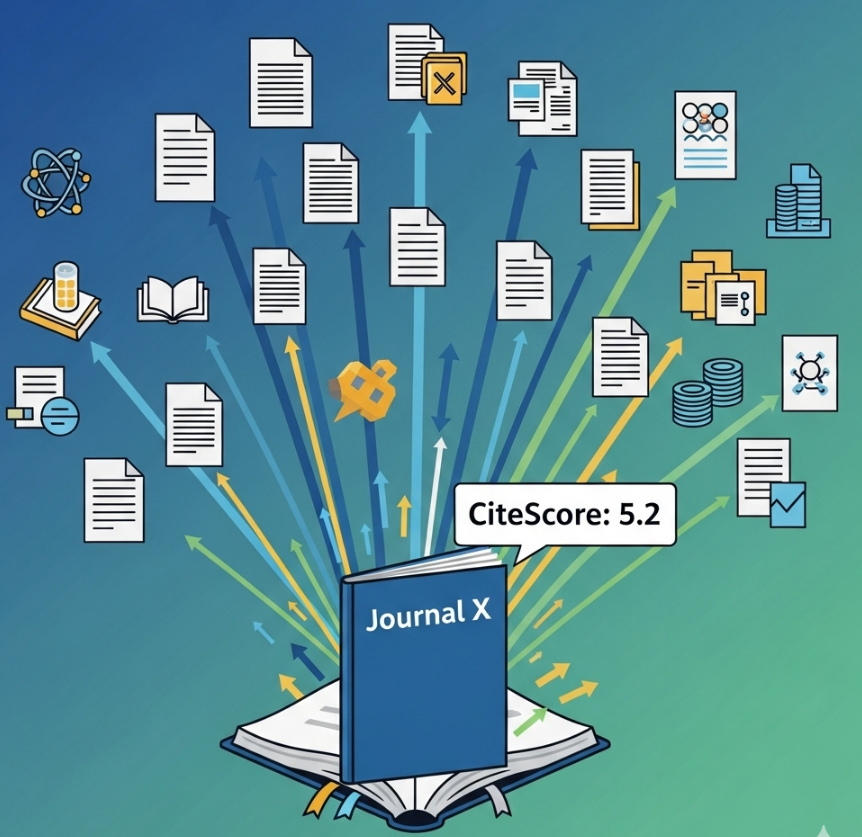
What is CiteScore? A Clear Definition
CiteScore is a journal performance metric developed by Elsevier, one of the world's major academic publishers. It reflects the average number of citations received in a recent year by documents published in that journal over the three previous years.
Launched in 2016, CiteScore uses data from the Scopus database, which is one of the largest abstract and citation databases of peer-reviewed literature. The metric was designed to be more comprehensive, transparent, and current than traditional metrics.
How is CiteScore Calculated?
The calculation for CiteScore is straightforward and transparent. For any given year (e.g., 2024), the calculation is as follows:
Formula:
Let's break it down with an example: Imagine a journal published:
-
100 articles in 2020
-
120 articles in 2021
-
130 articles in 2022
In 2023, these 350 articles collectively received a total of 1,400 citations.
The CiteScore for 2023 would be:
So, the journal's CiteScore for 2023 is 4.0.
CiteScore vs. Impact Factor: What's the Difference?
CiteScore is often compared to the Journal Impact Factor (JIF). While they both aim to measure journal influence, they have key differences:
Where Can You Find a Journal's CiteScore?
Finding a journal's CiteScore is easy and free:
-
Scopus Website: Go to the "Sources" page on https://www.google.com/search?q=Scopus.com to search for a journal and view its detailed metrics.
-
Journal Homepage: Most journals indexed in Scopus proudly display their CiteScore on their main webpage.
Benefits and Limitations of CiteScore
Benefits:
-
Transparency: The calculation is simple and the underlying data (citations and documents) is viewable in Scopus.
-
Comprehensiveness: It is based on the larger Scopus database and includes a wider range of document types.
-
Currency: The CiteScore Tracker provides monthly updates, showing how the current year's score is developing.
Limitations:
-
Field-Dependent: Like all metrics, CiteScore values vary widely across different academic disciplines. You should only compare journals within the same field.
-
Potential for Manipulation: No metric is immune to potential manipulation, such as through self-citation or citation stacking.
-
Doesn't Measure Individual Paper Quality: A high CiteScore indicates the average impact of a journal, not the quality of any single article within it.
Conclusion
CiteScore is a powerful and transparent tool in the modern researcher's toolkit. By providing a broader and more accessible measure of a journal's citation impact, it offers a valuable alternative and complement to the traditional Impact Factor. When used correctly—by comparing journals within the same field and in conjunction with other qualitative assessments—CiteScore can help you make more informed decisions about where to read, cite, and publish your most important work.