
SCI Conference Papers vs. SCI Journal Papers: Understanding the Key Differences
SCI Conference Papers vs. SCI Journal Papers: Understanding the Key Differences
For researchers, publishing in SCI (Science Citation Index) indexed venues is a hallmark of quality and impact. However, a common point of confusion arises when distinguishing between "SCI conference papers" and "SCI journal papers." While both can contribute to your publication record and disseminate your research, they represent distinct publication formats with different purposes, review processes, and academic impacts.
Understanding these differences is crucial for strategically planning your publication trajectory and maximizing the visibility and recognition of your work. This guide will clarify the nuances between these two important types of scholarly output.
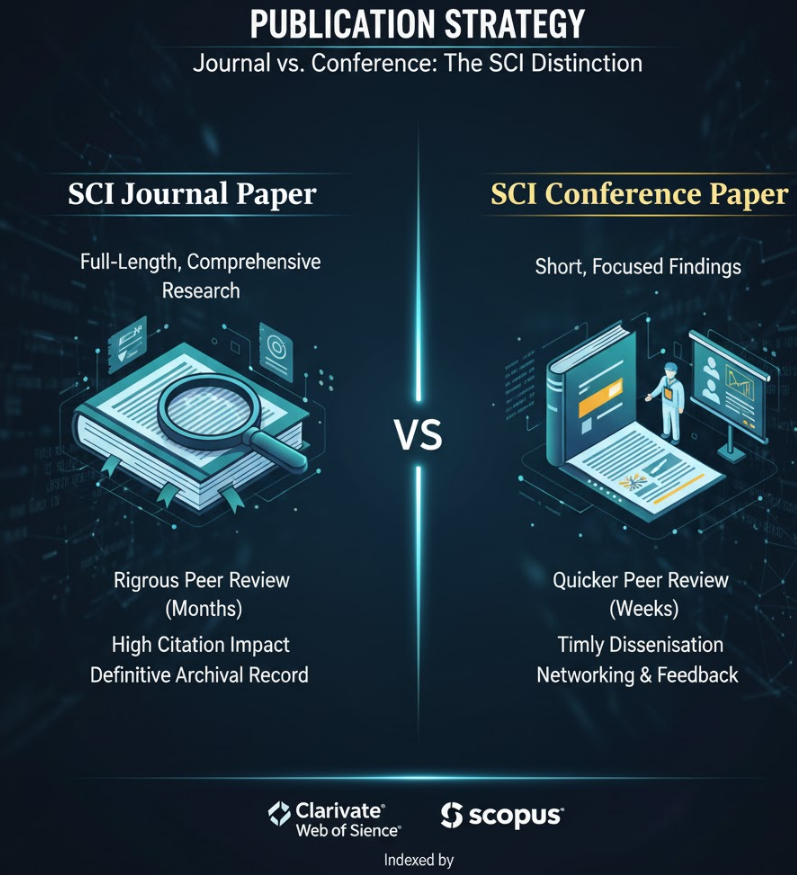
The fundamental difference lies in where the research is published and the depth of presentation expected.
What is an "SCI Journal Paper"?
An SCI Journal Paper is an article published in a scientific journal that is officially indexed by Clarivate's Science Citation Index (SCI) or its expanded version, Science Citation Index Expanded (SCIE). These journals undergo a rigorous evaluation process by Clarivate to ensure they meet high standards of scientific quality, editorial rigor, and citation impact.
- Characteristics: Typically a full-length, comprehensive article detailing a complete study, from theoretical background to detailed methodology, results, discussion, and conclusions.
An "SCI Conference Paper" refers to a paper (often an abstract, extended abstract, or short paper) that is presented at an academic conference, and whose proceedings are subsequently indexed by SCI/SCIE (or other Clarivate indices like CPCI - Conference Proceedings Citation Index). Not all conference proceedings are indexed by SCI; only those that meet specific quality criteria set by Clarivate for conference publications.
- Characteristics: Generally shorter and more focused than journal papers. They often present preliminary findings, novel ideas, or specific technical contributions that might be part of a larger ongoing research project.
| Feature | SCI Journal Paper | SCI Conference Paper |
|---|---|---|
| Purpose | Comprehensive, definitive account of a complete study; archival record. | Timely dissemination of new results, ideas, or work-in-progress; networking. |
| Length & Scope | Full-length (e.g., 5,000-10,000+ words); in-depth background, methods, results, discussion. | Shorter (e.g., 4-10 pages); concise, often highlights preliminary or specific findings. |
| Review Process | Rigorous peer review (double-blind or single-blind); multiple rounds of revisions over months. Focus on novelty, soundness, completeness, impact. | Peer review (often single-blind); typically quicker, less in-depth than journals. Focus on relevance, novelty, and suitability for conference theme. |
| Publication Format | Published in a specific issue of a peer-reviewed journal. | Published in conference proceedings (print or online), often as part of a series (e.g., IEEE Xplore, ACM Digital Library, Springer Lecture Notes). |
| Archival Value | Considered the primary archival record; often the definitive version of research. | Can be archival, but often represents work that will be expanded and published in a journal later. |
| Citation Impact | Generally higher citation impact; contributes directly to Journal Impact Factor. | Varies; can be cited, but typically less than full journal papers. Contributes to researcher's h-index. |
| Originality Expectation | High expectation of novel, complete research that makes a significant contribution. | Expectation of novelty, but can also be for new perspectives, preliminary results, or technical demos. |
| Time to Publication | Months to over a year. | Weeks to a few months. |
When to Choose Which?
Choose an SCI Journal Paper When:
- Your research is complete, with robust data, thorough analysis, and well-supported conclusions.
- You want to provide a comprehensive and definitive account of your work.
- You are aiming for the highest possible citation impact and archival value.
- You are prepared for a lengthy and rigorous review process.
- You have preliminary findings, novel ideas, or specific technical contributions that you want to share quickly.
- You want to get early feedback from peers to refine your research before a full journal submission.
- You want to network with others in your field and discuss your work in an interactive setting.
- You have time-sensitive results that need rapid dissemination.
- You plan to expand the work into a full journal paper later (check the journal's self-plagiarism policy).
It's also important to understand the indexing services:
- SCI/SCIE (Science Citation Index Expanded): Part of Web of Science (Clarivate Analytics). Known for its highly selective criteria, focusing on influential journals.
- Scopus: A large abstract and citation database owned by Elsevier. Broader coverage than SCI, including more journals, conference proceedings, and books.
- EI Compendex: A comprehensive engineering abstract and citation database owned by Engineering Village. Strong focus on engineering and applied science conference proceedings and journals.
Conclusion
Both SCI journal papers and SCI-indexed conference papers are valuable forms of scholarly output. While journal papers serve as the primary archival record and typically carry more weight in academic evaluations due to their depth and rigorous review, conference papers play a crucial role in the timely dissemination of new ideas, early feedback, and professional networking. A balanced publication strategy often involves leveraging both formats to effectively share your research and contribute to your academic field.