
How to Successfully Publish Your First Paper in an IEEE Journal (A Detailed Submission Guide)
Publishing a paper in a prestigious Institute of Electrical and Electronics Engineers (IEEE) journal is a significant milestone for any researcher, engineer, or student. It signifies a valuable contribution to your field and can significantly boost your academic and professional career. However, for first-time authors, the process can seem complex and intimidating.
This comprehensive guide breaks down the entire journey, from manuscript preparation to navigating the peer review process, providing you with a clear, step-by-step roadmap to get your first paper published in an IEEE journal.
Phase 1: Pre-Submission – Laying the Groundwork for Success
Before you even think about the submission portal, meticulous preparation is key. This phase is about ensuring your research is polished and presented in the most professional manner possible.
1. Start with High-Quality Research This is the non-negotiable foundation. Your research must be:
-
Original: It should present new findings, methods, or insights.
-
Significant: It should address a relevant problem or question in your field.
-
Technically Sound: Your methodology, experiments, and analysis must be robust and repeatable.
A paper is only as good as the research behind it. Ensure your work is complete and your conclusions are well-supported by data before you start writing.
2. Choose the Right IEEE Journal With hundreds of publications, selecting the correct journal is crucial. Submitting to an inappropriate journal is one of the fastest ways to get a "desk rejection."
-
Check Aims & Scope: Carefully read the "Aims & Scope" or "About the Journal" section on the journal's website. Does your research align perfectly with it?
-
Read Past Issues: Browse recent articles in the journal. Is your work of a similar type and quality? This also helps you understand the expected tone and structure.
-
Use the IEEE Publication Recommender: This powerful tool allows you to paste your abstract or keywords to get a list of relevant IEEE journals, conferences, and magazines.
3. Master the IEEE Format and Style IEEE has strict formatting guidelines. Adhering to them shows professionalism and respect for the review process.
-
Download the Template: Visit the IEEE Author Center to download the official Microsoft Word or LaTeX templates. Using them from the start will save you a lot of time.
-
Pay Attention to Details: Follow the guidelines for fonts, columns, headings, figure captions, and especially reference style (e.g.,
[1], [2]).
Phase 2: The Detailed Submission Process – A Step-by-Step Walkthrough
Once your manuscript is perfectly formatted and proofread, you are ready to submit. Most IEEE journals use an online portal like ScholarOne Manuscripts.
Step 1: Prepare Your Final Files Organize all required files in a single folder. This typically includes:
-
The Manuscript: Usually in PDF or Word format.
-
High-Resolution Figures: Each figure saved as a separate file (e.g., TIFF, EPS, PNG) with high resolution (300-600 DPI).
-
Editable Source File: The original Word or LaTeX source file.
-
Cover Letter: A brief, professional letter to the editor-in-chief.
-
Supplementary Materials (if any): Datasets, code, or extended proofs.
Step 2: Write a Compelling Cover Letter Your cover letter is your first introduction to the editor. Keep it concise and professional. Include:
-
The title of your manuscript.
-
A brief summary of your research and its key findings.
-
A clear statement explaining why your work is a good fit for this specific journal.
-
A declaration that the work is original and not under consideration by any other journal.
Step 3: Navigate the Submission Portal Create an account on the journal's submission website. The process is generally a multi-step wizard:
-
Enter Manuscript Details: Type or paste in the title, abstract, and keywords. Ensure they match your manuscript exactly.
-
Add Authors: Enter the names, affiliations, and contact details for all co-authors.
-
Upload Files: Upload each file according to the instructions (e.g., manuscript, figures, cover letter). The system will usually combine them into a single PDF for review.
-
Suggest Reviewers (Optional but Recommended): You may be asked to suggest 3-5 potential reviewers. Choose experts in your field who have no conflict of interest.
-
Final Review: The system will generate a proof (a merged PDF). Carefully review it to ensure everything is correct—text, figures, and formatting.
Step 4: Click "Submit" After your final check, officially submit your manuscript. You will receive an email confirmation with a manuscript ID number. Use this number for any future correspondence.
Phase 3: Post-Submission – The Peer Review Journey
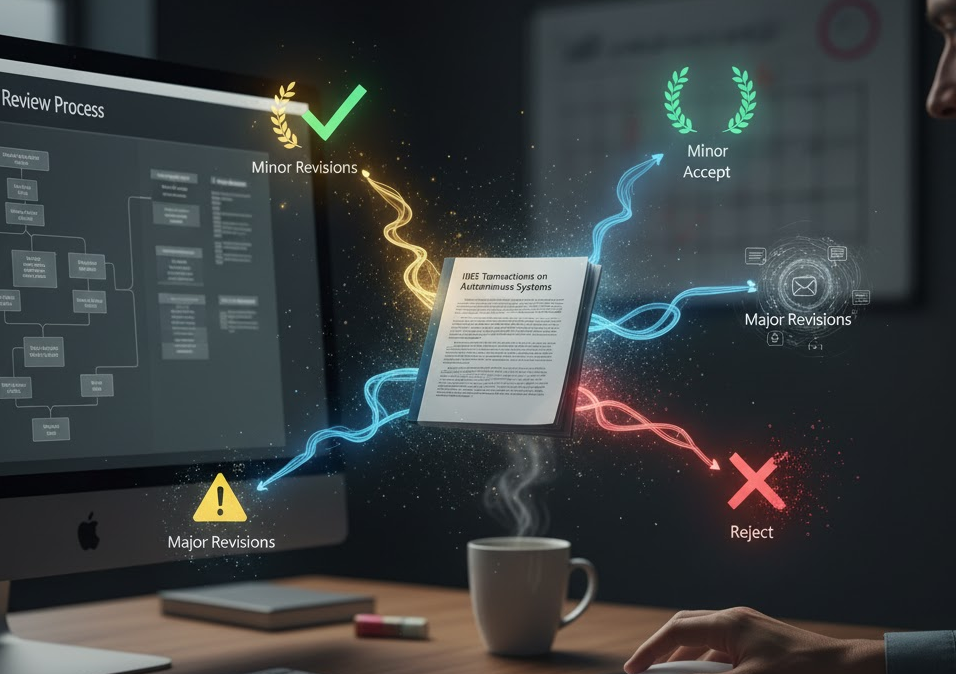
Patience is essential during this phase, which can take several weeks to months. An editor will first screen your paper. If it passes, it will be sent to 2-3 independent experts for peer review. The possible outcomes are:
-
Accept: This is rare for a first submission but is the best possible outcome.
-
Minor Revisions: You are asked to make small clarifications or edits. This is a very positive sign.
-
Major Revisions: The paper has potential, but significant changes are needed. You will need to carefully address all reviewer comments and resubmit.
-
Reject: The paper is not accepted for publication. While disappointing, use the reviewer feedback to improve your work for submission to another journal.
When responding to reviewer comments, be polite, professional, and systematic. Create a "Response to Reviewers" document that addresses each comment point-by-point, explaining the changes you made.
Conclusion
Publishing your first paper in an IEEE journal is a challenging but highly rewarding process. Success depends on a combination of strong research, meticulous preparation, strategic journal selection, and persistence. By following this detailed guide, you can navigate the submission and review process with confidence and significantly increase your chances of seeing your work published.