
Red Flags of Predatory Conferences: 8 Signs to Identify Academic Traps
For researchers and academics, conferences are vital for disseminating findings, networking, and receiving critical feedback. However, a dark side to this world exists: predatory conferences.
These events are academic scams designed for one purpose—to extract high registration fees from unsuspecting scholars. They offer no legitimate peer review, no real academic value, and can actively damage your professional reputation.
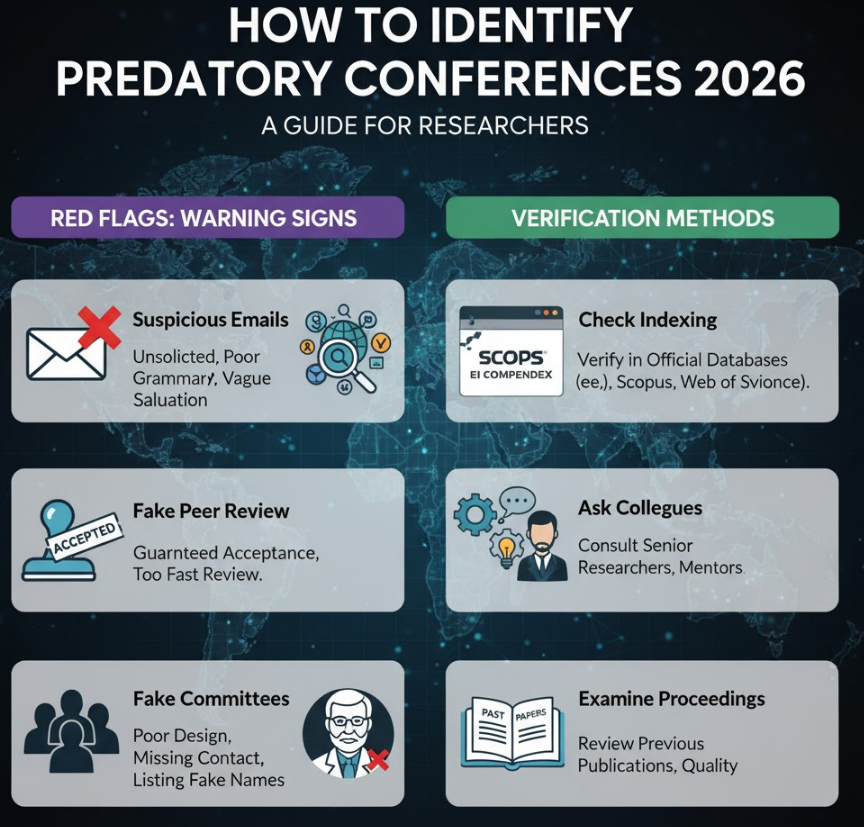
Knowing how to spot these traps is a crucial skill for every researcher. Here are the eight most common red flags of a predatory conference.
1. The Unsolicited "Spam" Invitation
This is the most common first warning sign. You receive an email, often from a generic (Gmail, Outlook) address, with several tell-tale characteristics:
-
Over-the-Top Flattery: The email addresses you as a "Distinguished Professor" or "Eminent Researcher" but is vague about your actual work.
-
Poor Grammar: The invitation is filled with spelling errors and awkward phrasing that a professional organizing committee would have proofread.
-
Irrelevant Field: You're a materials scientist being invited to speak at a conference on social media marketing.
2. The "Too Broad" Conference Theme
Legitimate conferences have specific, niche topics. Predatory conferences create names that are absurdly broad to attract the largest possible number of submissions.
-
Example Names: "The World Congress on Science, Engineering, and Technology" or "International Journal of Multidisciplinary Research."
-
Mimicry: They often use names and acronyms that sound confusingly similar to prestigious, well-known conferences (e.g., those run by IEEE or ACM).
3. Promises of "Rapid Peer Review" or "Guaranteed Acceptance"
This is the most critical red flag. Academic rigor is built on peer review.
-
The "24-Hour" Review: Legitimate peer review takes weeks, sometimes months. A conference promising feedback in "24-72 hours" or "by next business day" is a scam.
-
Guaranteed Publication: Their goal is your money, not quality control. If acceptance seems guaranteed, it's not a real academic event.
4. A Low-Quality or Suspicious Website
A conference's website is its digital storefront. Predatory sites are often riddled with problems:
-
Stock Photos: The website uses blurry stock photos of a city (e.g., the Eiffel Tower for a conference in Dubai) that have no connection to the event.
-
Missing Information: There is no detailed agenda, no information on the organizing committee, and no specific venue—only a vague location like "Beijing, China."
-
Suspicious Contact: The only contact method is a web form or a generic free email address.
5. A Phantom Organizing Committee
Predatory conferences fabricate their committees and keynote speakers to appear legitimate.
-
"Kidnapped" Experts: They list well-known academics on their site as keynote speakers or committee members without their permission.
-
Check for Yourself: If you are suspicious, do a quick search. Even better, send a polite, brief email to one of the listed speakers and ask if they are genuinely affiliated with the event.
6. High Fees and Opaque Refund Policies
The entire operation is designed to get your money.
-
Hidden Costs: The fee schedule may be unclear until after your paper is "accepted."
-
No Refunds: They will have a strict "no refund under any circumstances" policy. Once you pay, your money is gone.
7. False Indexing and Publication Promises
To lure you in, they make grand promises that your paper will be indexed in Scopus, Ei Compendex, or Web of Science (SCI). These are almost always lies.
-
How to Verify: Check the proceedings from the conference's past events. See if those papers were actually indexed in the databases they claim. Be extra skeptical of brand-new conferences making these promises.
8. The "Bait-and-Switch" Venue
To seem exciting, these conferences are often "located" in popular tourist destinations like Paris, Rome, or Dubai.
-
The Switch: Shortly before the event, organizers will announce that "due to unforeseen circumstances," the conference has been moved online or to a cheap airport hotel. The high registration fee, of course, will not be refunded.
Conclusion_
The best defense against predatory conferences is diligence. Before you submit a paper or pay a single dollar, do your research. Ask your mentors and colleagues if they've heard of the organizer. Verify the committee members. And above all, trust your gut—if an offer seems too good to be true, it almost certainly is.