
The Researcher's Guide to Writing Winning Conference Papers (IEEE/Scopus)
Here are two additional professional SEO articles based on the same topic but approached from slightly different angles to target broader search intents.
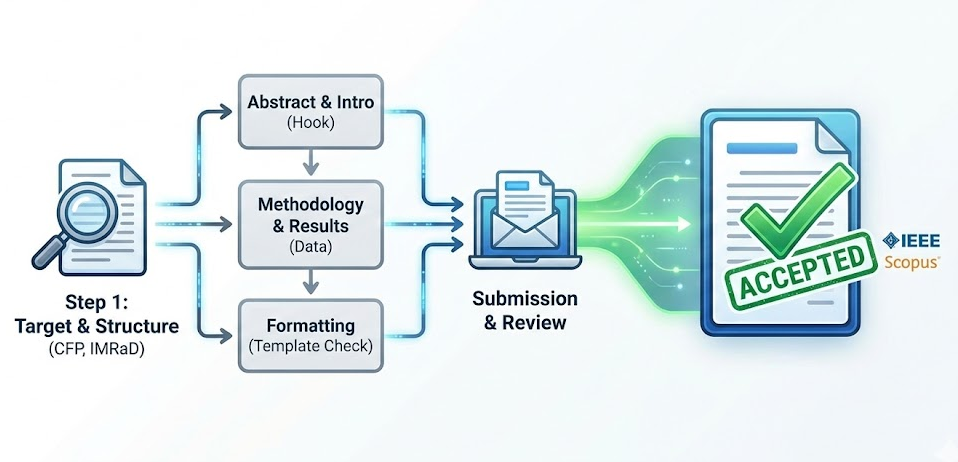
Article Option 1: Focus on "Avoiding Rejection"
Title: 5 Reasons Conference Papers Get Rejected (And How to Ensure Acceptance)
Body:
The acceptance rates for top-tier academic conferences (such as CVPR, ICML, or major IEEE symposiums) can be notoriously low, often ranging between 15% and 25%. For researchers, receiving a rejection letter is discouraging, but it is often preventable.
Understanding why reviewers reject papers is the secret to getting yours accepted. Most rejections are not due to "bad science," but rather poor presentation or lack of clarity.
Here are the top five reasons conference papers are rejected and how you can avoid them to ensure your work gets indexed in EI Compendex and Scopus.
1. "Out of Scope" (The Desk Reject)
This is the most painful error because it is 100% avoidable. If you submit a pure software engineering paper to a hardware-focused conference, it will be rejected immediately.
-
The Fix: Read the "Call for Papers" (CFP) tracks carefully. Tailor your Introduction to explicitly mention how your work fits into the conference's specific theme.
2. The "So What?" Factor (Lack of Contribution)
Reviewers need to see the novelty immediately. If your Introduction is just a history lesson without stating what you did differently, you will lose them.
-
The Fix: Use the "Magic Sentence" in your introduction: "To the best of our knowledge, this is the first study to..." or "Unlike previous approaches, our method..."
3. Poor English and Structure
Reviewers are volunteers. If they have to struggle to understand your grammar or follow your logic, they will likely reject the paper.
-
The Fix: Stick to the IMRaD structure (Introduction, Methods, Results, Discussion). Use short sentences and active verbs. Always have a native speaker or a professional tool proofread your draft.
4. Unconvincing Experiments
In fields like AI and Data Science, claiming a result without comparing it to the "State-of-the-Art" (SOTA) is a red flag.
-
The Fix: Your Results section must include a comparison table. Show your method alongside the top 3 competing methods and clearly highlight where yours is superior (e.g., accuracy, speed, or efficiency).
5. Formatting Violations
IEEE and ACM are strict. Exceeding the page limit, changing margins, or using the wrong font size can lead to an automatic rejection.
-
The Fix: Never modify the official template. If you need to save space, rewrite your text; do not shrink the margins.
Conclusion Getting accepted is about removing friction for the reviewer. By avoiding these five pitfalls, you present a professional, polished paper that makes it easy for the committee to say "Yes."