
The Ultimate Guide to Writing a Perfect Academic Abstract (with Examples)
Your abstract is the single most important paragraph in your entire research paper. Why? Because it is often the only part people will read.
In search engines like Google Scholar or databases like Scopus, the abstract is your "movie trailer."
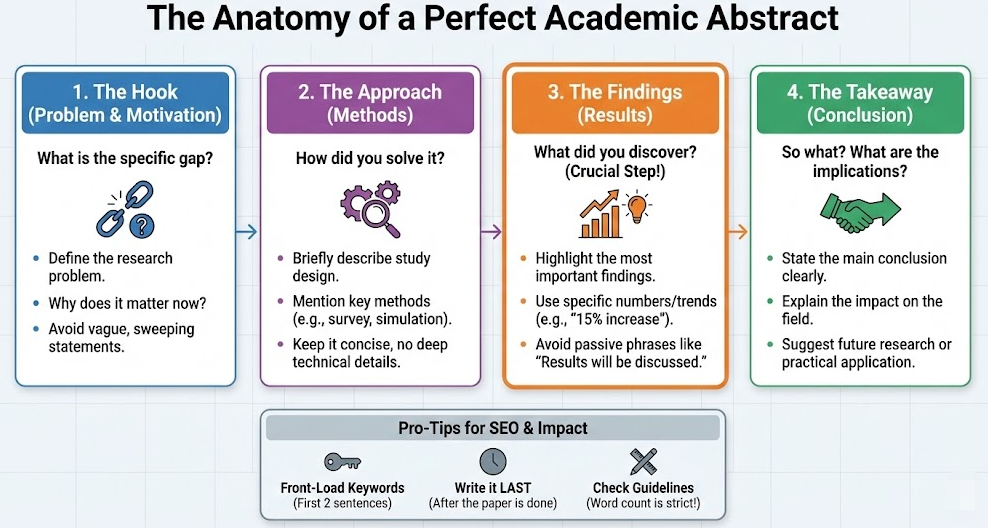
Whether you are writing a thesis, a dissertation, or a journal article, the formula for a high-impact abstract is remarkably consistent. This guide breaks down the structure, provides professional examples, and highlights the common traps to avoid.
The 4-Step Formula for a Perfect Abstract
A standard abstract is typically 150–250 words.
1. The Hook (The Problem & Motivation) – 1-2 Sentences Don't start with a broad, sweeping statement like "Since the dawn of time..." Start with the specific gap in knowledge.
-
Ask yourself: What is the specific problem? Why does it matter right now?
2. The Approach (The Methods) – 1-2 Sentences Briefly describe how you solved the problem. Don't get bogged down in technical minutiae.
-
Ask yourself: Did I do a survey? A simulation? A case study? What was the sample size?
3. The Findings (The Results) – 2-3 Sentences This is the most critical section. Avoid vague phrases like "Results will be discussed." Be specific.
-
Ask yourself: What is the most important number, trend, or discovery? (e.g., "We found a 15% increase in efficiency...")
4. The Takeaway (The Conclusion/Implication) – 1 Sentence Finish strong. Explain the "So What?"
-
Ask yourself: How does this change the field? What should researchers or practitioners do differently now?
Real-World Examples: The Bad vs. The Good
Let’s look at a hypothetical paper about remote work and employee burnout.
❌ The Bad Abstract (Vague and Passive)
"Remote work has become very popular recently. Many companies are now using hybrid models. This paper explores the relationship between working from home and employee mental health. We surveyed many employees from different sectors. The results show that there are both positive and negative effects of remote work. The paper concludes by suggesting that managers need to be careful. Implications for future research are discussed."
-
Critique: It tells us nothing. "Many employees"? "Positive and negative effects"? This is a teaser, not a summary. A researcher reading this has no idea if the paper is relevant to them.
✅ The Good Abstract (Specific and Active)
"(Problem) While remote work offers flexibility, its long-term impact on employee burnout remains debated, specifically regarding the 'always-on' culture. (Methods) To investigate this, we conducted a longitudinal survey of 500 tech-sector employees over 12 months, comparing fully remote vs. hybrid teams. (Results) The data reveals that fully remote employees reported a 20% higher burnout rate compared to hybrid workers, primarily driven by a lack of clear boundaries between work and personal time. Interestingly, productivity metrics remained equal across both groups. (Conclusion) These findings suggest that while remote work sustains productivity, hybrid models may be more sustainable for long-term employee well-being, necessitating new 'right-to-disconnect' policies."
-
Why it wins: It defines the gap (burnout debate), details the method (500 tech employees, longitudinal), gives hard numbers (20% higher burnout), and offers a concrete implication (hybrid is better for well-being).
3 Pro-Tips for Maximum SEO Visibility
Since you want your paper to be found in Google Scholar and IEEE Xplore, you must treat your abstract like SEO content.
-
Front-Load Your Keywords: Ensure the most important keywords for your field (e.g., "Machine Learning," "Cognitive Behavioral Therapy," "Supply Chain Resilience") appear in the first two sentences.
-
Write it LAST: Never write the abstract first. You cannot summarize what you haven't written. Finish your paper, then extract the key sentences from each section to build your draft.
-
Check the Guidelines: Journals are strict. If the limit is 250 words, do not submit 251. If they ask for a "Structured Abstract" (with explicit headings), follow that format rigorously.
Conclusion
A perfect abstract is a sales pitch.