
What Does "Under Review" Mean in Submission Systems?
For authors, this phrase is a source of immense anxiety. Does it mean the editor is reading it? Are reviewers fighting over it? Or has it been forgotten in a digital drawer?
In 2026, submission systems like ScholarOne, Editorial Manager, and Open Journal Systems (OJS) use this term to cover several different stages. Here is how to decode what is actually happening behind the screen.
1. The Three Meanings of "Under Review"
Depending on when you see this status, it indicates three very different realities.
Phase A: The "Fake" Under Review (Days 1-7)
If your status changes to "Under Review" immediately after submission (or within 24 hours), it does not mean peer reviewers have it yet.
-
Reality: The paper is currently with the Administrator or the Managing Editor for a "Desk Check" (formatting and plagiarism scan).
-
Next Step: It will either move to "Editor Assigned" or be "Desk Rejected."
Phase B: The "Real" Under Review (Weeks 2-12)
If the status changed from "Editor Assigned" or "With Editor" to "Under Review," the process has officially begun.
-
Reality: Invitations have been sent, and at least one reviewer has accepted the invitation.
-
The Wait: This is the longest phase. The editor is waiting for 2 or 3 independent experts to submit their reports.
Phase C: The "Limping" Under Review (Month 4+)
If it has been months, one reviewer might be ghosting the editor.
-
Reality: Reviewer #1 submitted their report weeks ago, but Reviewer #2 is late. The system will keep saying "Under Review" until all required reports are in.
2. The "Date Change" Clue (The Secret Trick)
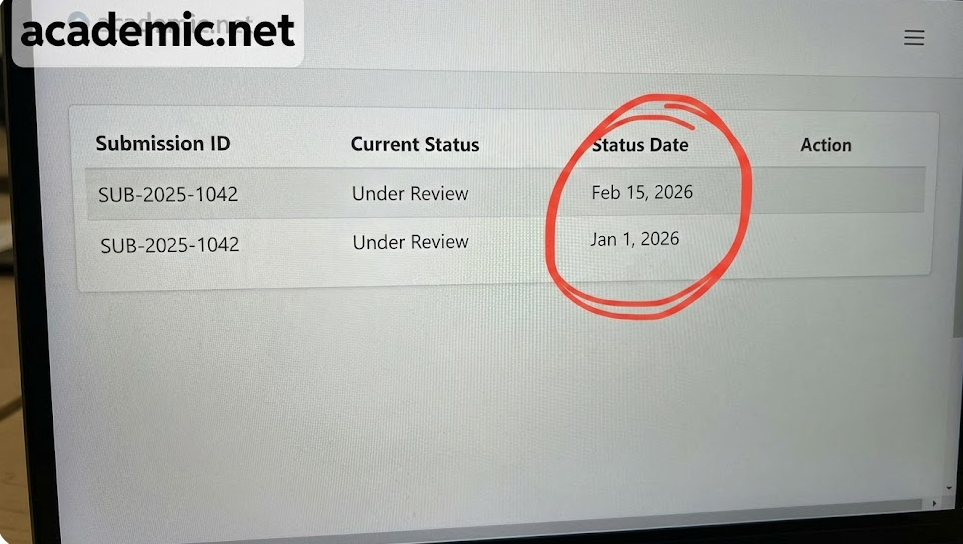
Most authors miss this. In systems like Elsevier (Editorial Manager), watch the "Status Date" column, not just the "Status" text.
-
Scenario: The status is "Under Review" on Jan 5.
-
Update: On Feb 10, the status is still "Under Review," but the date changed to Feb 10.
-
Meaning: Good News! This usually means one reviewer has just logged a review. The system updated the timestamp because a new event occurred, even though the overall status didn't change because the second review is still missing.
3. System-Specific Rosetta Stone
Different publishers use different dictionaries. Here is a translation guide for 2026:
| System / Publisher | Status Text | Translation |
| Elsevier (Editorial Manager) | Required Reviews Completed | All reviewers are done. The Editor is reading the reports now. You will get a decision in ~1 week. |
| ScholarOne (IEEE/Taylor) | Awaiting Reviewer Scores | Reviewers have accepted but haven't uploaded files yet. |
| ScholarOne (IEEE/Taylor) | Awaiting AE Recommendation | Reviews are in. The Associate Editor is deciding whether to Reject or Revise. |
| Springer | Editor Assigned | This can last weeks. It means they are trying to find reviewers but everyone is declining. |
4. When Should You Panic? (And Send an Email)
How long is "too long"? It depends on the field.
-
Computer Science / Engineering: Normal is 2-4 months. Panic after 5 months.
-
Mathematics / Social Sciences: Normal is 4-9 months. Panic after 10 months.
-
Medicine / Biology: Normal is 1-2 months. Panic after 3 months.
The Polite Inquiry Template:
If you pass the "Panic Threshold," send a polite email to the journal secretary (not the Editor-in-Chief directly).
"Dear [Journal Name] Editorial Office,
My manuscript [ID: 12345] has been 'Under Review' for [X] months. I understand the review process takes time, but I wanted to respectfully inquire if there are any difficulties in securing reviewers. I am happy to provide additional reviewer suggestions if needed.
Sincerely, [Your Name]"