
Full Paper vs Abstract Submission: Which Should You Choose?
When searching for upcoming conferences on academic directories like call4papers.org or uconf.com, you will frequently notice organizers offering two distinct tracks: Abstract Submission and Full Paper Submission.
For early-career researchers and graduate students, deciding which track to choose can be confusing. Choosing the wrong one might mean missing out on a publication credit or committing to a workload you cannot finish in time.
Here is a definitive guide to the differences between full papers and abstracts, and how to choose the right strategy for your current research phase.
1. What is an Abstract Submission?
An abstract submission requires you to send only a brief summary of your research, typically ranging from 200 to 500 words. It outlines your background, methodology, and preliminary results.
The Outcome: If accepted, you will be invited to present your work at the conference (either as an oral presentation or a poster). However, your work will generally not be published in the formal conference proceedings. It may only appear in a "Book of Abstracts" given to attendees.
Pros:
-
Requires less time to prepare.
-
Perfect for ongoing research where final data is not yet available.
-
Allows you to secure a speaking slot and get feedback before writing the complete manuscript.
Cons:
-
Does not usually count as a formal "publication" for graduation or tenure requirements.
-
Not indexed in major databases like Scopus or EI Compendex.
2. What is a Full Paper Submission?
A full paper submission requires you to submit a complete, formatted manuscript (usually 4 to 10 pages) detailing your entire study, including comprehensive literature reviews, deep data analysis, and a full reference list.
The Outcome: If accepted after a rigorous peer-review process, you will be invited to present, and your manuscript will be officially published in the conference proceedings.
Pros:
-
Results in a formal, peer-reviewed academic publication.
-
Highly likely to be indexed in major academic databases (IEEE Xplore, Springer, Scopus, EI), which builds your academic CV.
-
Establishes a permanent public record of your intellectual property.
Cons:
-
High rejection rates, as the peer-review process is much stricter.
-
Requires a massive time investment to write, format, and revise before the deadline.
Quick Comparison
| Feature | Abstract Submission | Full Paper Submission |
| Length | 200 - 500 words | 4 - 10+ pages |
| Preparation Time | Days | Weeks or Months |
| Review Process | Light (Checks for relevance) | Rigorous (Full peer review) |
| Primary Goal | Discussion, Networking, Feedback | Formal Publication, Indexing |
| Graduation Credit | Rarely counts | Usually counts (depending on index) |
How to Choose the Right Track
Your decision should be dictated by what you need out of the conference.
Choose the Abstract Track if:
-
Your research is still in the early phases and you need expert feedback to steer your methodology.
-
You plan to submit the full, completed study to a high-impact SCI journal later, and you do not want to risk "self-plagiarism" by publishing the data in a conference proceeding first.
-
You simply want to attend the conference for networking purposes and need a reason to secure travel funding from your university.
Choose the Full Paper Track if:
-
Your research is complete, and your data is finalized.
-
You are a Computer Science or Engineering student who needs an EI-indexed or Scopus-indexed publication to meet graduation quotas.
-
You want to quickly claim ownership of a novel idea in a fast-moving field before someone else publishes it.
Summary
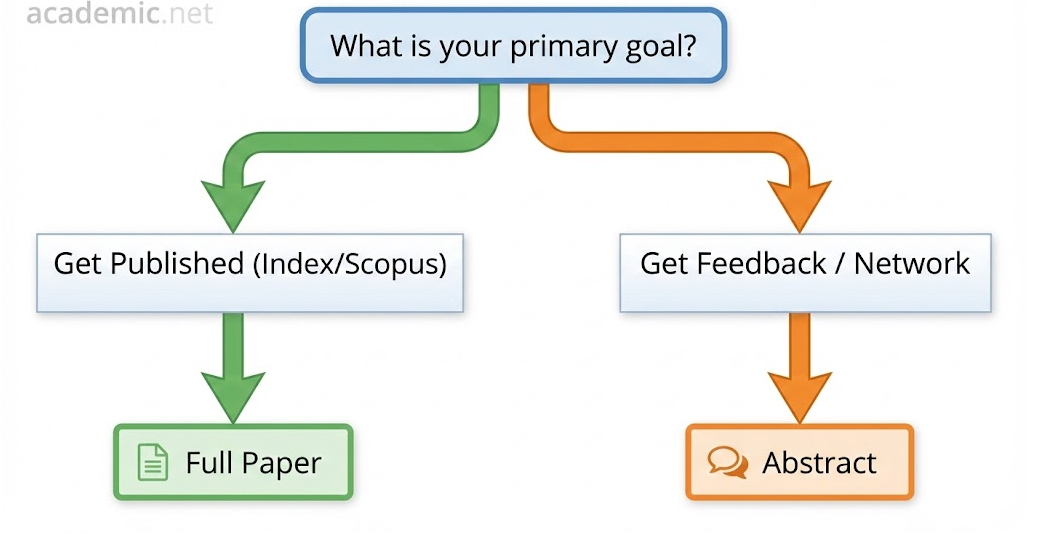
The choice between an abstract and a full paper comes down to Feedback vs. Publication. Use the abstract track to test the waters and build connections, and use the full paper track to build your academic resume and satisfy degree requirements.