
Self-Plagiarism & Dual Submission Policies in Academia
In the highly competitive landscape of academic publishing, the pressure to maintain a steady output of papers can lead researchers to make critical ethical mistakes. Two of the most common—and most heavily penalized—violations are Dual Submission and Self-Plagiarism.
While authors often assume that because they wrote the text, they can do whatever they want with it, academic copyright and peer-review ethics dictate otherwise.
Here is a definitive guide to understanding these policies, the authorized exceptions, and how modern conference platforms detect violations.
1. What is Dual Submission?
Dual submission (also known as multiple or concurrent submission) occurs when an author submits the exact same research manuscript to two or more publishing venues (journals, conferences, or book chapters) at the same time.
Why Authors Do It: Researchers usually attempt this to save time. If Journal A takes six months to review a paper, they might simultaneously submit it to Conference B, hoping whoever accepts it first will be the final venue, after which they will withdraw the other submission.
Why It Is Strictly Prohibited:
- Wasted Resources: Peer review relies on the unpaid, volunteer labor of academic experts. Sending one paper to multiple venues wastes the time of double the reviewers.
- Copyright Conflicts: When a paper is accepted, authors must sign a Copyright Transfer Agreement. If two venues accept the paper simultaneously, it creates a massive legal conflict over who actually owns the rights to publish the data.
Self-plagiarism occurs when an author reuses significant portions of their own previously published work in a new manuscript without proper attribution.
Even though you are not stealing from another researcher, you are deceiving the publisher and the reader into thinking this is entirely novel research.
Common Forms of Self-Plagiarism:
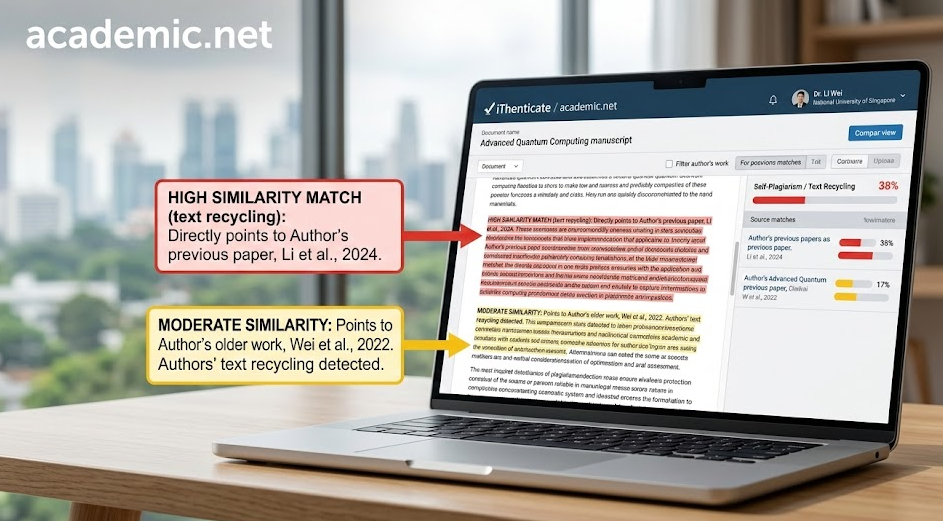
- Text Recycling: Copy-pasting entire paragraphs from your previous literature review or methodology section into a new paper.
- Data Re-publication: Publishing the exact same charts, graphs, or datasets in two different papers without clearly stating that the data was previously published.
- Salami Slicing: Taking the results of one comprehensive study and artificially slicing it into three or four "minimum publishable unit" papers just to inflate a publication count.
There is one universally accepted loophole to the self-plagiarism rule: extending a published conference paper into a full journal article.
In fields like Computer Science and Engineering, it is standard practice to present preliminary findings at a conference, gather feedback, and then submit a comprehensive version to a journal. However, you must follow the strict 30% Rule:
- Significant New Material: The journal submission must contain at least 30% to 50% new content. This usually means adding deeper data analysis, broader literature reviews, or entirely new experiments.
- Title Change: The title of the journal article should be different from the conference proceeding.
- Explicit Citation: You must explicitly cite your own conference paper in the introduction (e.g., "This manuscript extends the preliminary findings originally presented at [Conference Name] [1].").
Authors who attempt to slip recycled text past reviewers rarely succeed in 2026. The backend technology used by academic publishers is highly automated.
When a researcher uploads a manuscript to submission portals and academic directories (such as uconf.com, icfp.net, iconf.com, or call4papers.org), the system almost always routes the PDF through similarity-checking APIs like Crossref Similarity Check (powered by iThenticate).
These tools do not just scan the public internet; they scan the proprietary, paywalled databases of IEEE, Elsevier, Springer, and ACM. If an author submits a paper containing text identical to an abstract they published three years ago, the Program Chair will immediately receive a similarity report highlighting the exact copied sentences.
5. The Penalties for Academic Misconduct
If an author is caught violating dual submission or self-plagiarism policies, the consequences extend far beyond a simple rejection.
- Immediate Desk Rejection: The paper is rejected before it even reaches the peer reviewers.
- Publisher Bans: Top-tier societies (like IEEE or ACM) may place the corresponding author—and sometimes the entire research lab—on a blacklist, banning them from submitting to any of their journals or conferences for 1 to 3 years.
- Retraction Notices: If the dual submission is discovered after publication, the paper will be formally retracted. A retraction notice featuring the author's name is permanently stamped on the digital library record, causing severe, long-term damage to their academic reputation.
In academic publishing, originality is the ultimate currency. If you are submitting a paper to a conference or journal, ensure it is the only venue currently reviewing it. If you need to reuse your own methodology or background text, treat yourself like any other author: summarize the concept and add a formal citation pointing back to your original work.