
Turnitin Similarity Score for Conference Papers: What is Safe? (2026)
Before your manuscript is ever read by a peer reviewer, it must pass an automated gatekeeper. Major academic publishers (such as IEEE, Springer, ACM, and Elsevier) and independent conference portals (like uconf.com or call4papers.org) use software like Turnitin or iThenticate to scan every submission for plagiarism.
If your similarity score is too high, your paper will face an immediate "desk rejection," regardless of how groundbreaking your data might be.
But what exactly is a "safe" score? Does a 15% match mean you plagiarized 15% of your paper? Here is the definitive guide to understanding Turnitin similarity scores for international academic conferences and how to ensure your manuscript passes the check.
1. The Acceptable Overall Percentage: The 20% Rule
While every conference committee sets its own exact threshold, there is a universally accepted industry standard across major engineering, science, and technology disciplines:
-
The Safe Zone (0% - 15%): Your paper is highly original. Any matches are likely just common academic phrasing, standardized methodology terms, or properly cited quotes.
-
The Borderline Zone (15% - 25%): Your paper will likely pass the automated filter, but the Program Chair will manually inspect the report to see where the matches are coming from.
-
The Danger Zone (Over 25%): In most top-tier conferences, an overall score exceeding 25% triggers an automatic desk rejection. The paper is returned to the author without peer review.
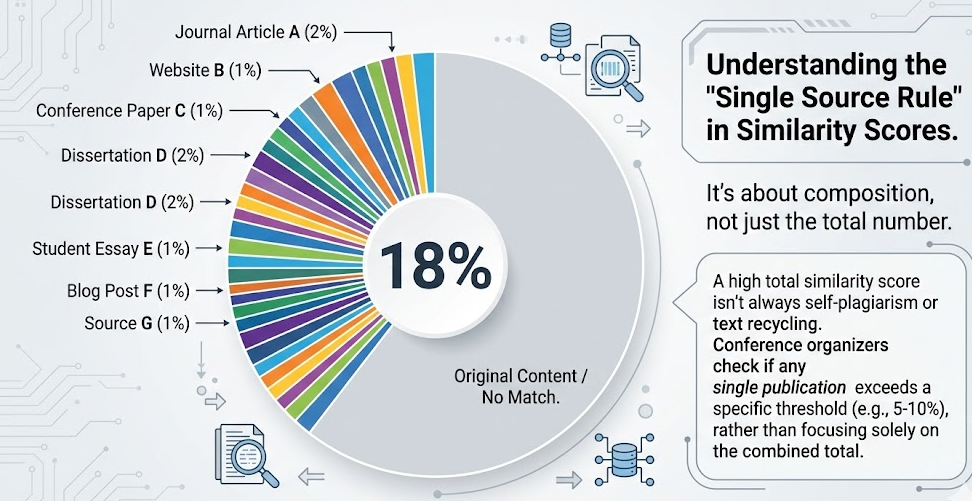
2. The "Single Source" Rule (Why 20% Can Still Get You Rejected)
Many graduate students obsess over the overall percentage and miss the most critical metric: the Single Source Match.
Turnitin does not just give one massive number; it breaks down exactly where the matching text comes from.
-
Scenario A: Your overall score is 18%, made up of 18 different sources that each match by 1%. (PASS)
-
Scenario B: Your overall score is 12%, but 10% of that comes from a single Wikipedia article or a single previously published paper. (FAIL)
The Rule: Major publishers dictate that no single source should account for more than 4% to 5% of your total similarity score. If one source matches heavily, it indicates you have copy-pasted a massive chunk of text rather than synthesizing the research in your own words.
3. "Similarity" Does Not Always Mean "Plagiarism"
Turnitin is a text-matching tool, not a plagiarism-detecting AI. It simply highlights words that appear elsewhere. Because of this, it frequently flags text that is perfectly legal to use.
Here are the most common reasons for a falsely inflated score:
-
The Reference List: Turnitin will often highlight your entire bibliography in red because those exact book and journal titles have been cited by thousands of other students. (Organizers usually filter this out manually).
-
Direct Quotes: If you quote a definition perfectly and put it in quotation marks with a citation, Turnitin still flags the text as a match.
-
Standardized Jargon: Phrases like "The purpose of this study was to investigate..." or specific chemical equations will always trigger a match. Do not destroy the grammar of your paper just to avoid matching common academic jargon.
4. The Trap of Self-Plagiarism
The most frequent reason experienced researchers fail the Turnitin check is self-plagiarism.
If you are expanding a previous conference abstract into a full paper, or if you copy-paste the methodology section from a paper you published three years ago, Turnitin will flag it. The system scans the publisher's own databases. Even if you wrote the original words, reusing them without citing your previous work is an ethical violation that will result in rejection.
5. How to Safely Lower Your Score Before Submission
If you run your paper through a checker and it comes back at 35%, do not panic. Use these steps to reduce it:
-
Paraphrase, Do Not Just Swap Synonyms: Do not just right-click and use a thesaurus on a copied sentence. Read the original source, close the tab, and type the concept out entirely from memory.
-
Condense Your Literature Review: High scores usually stem from the "Background" or "Literature Review" sections where authors heavily rely on previous work. Synthesize multiple papers into a single summary sentence rather than quoting each one individually.
-
Run a Pre-Check: Ask your university library if you have student access to Turnitin or iThenticate. Run a "draft check" before uploading the final version to the official conference portal. Warning: Ensure you submit it to the "No Repository" setting, or Turnitin will save your draft and show a 100% match when the conference scans the final version.